
Everyone can build an AI agent demo. Almost no one is shipping them. In 2026, 79% of enterprises say they've adopted AI agents — yet only 11% actually run them in production. That gap, not the models, is where most AI budgets quietly die.
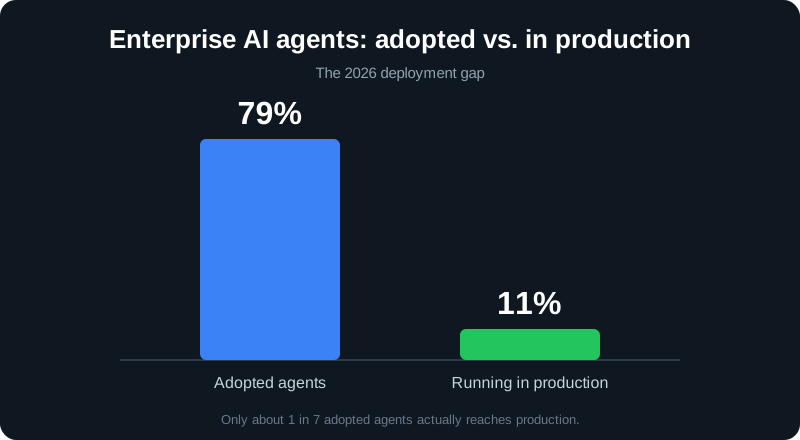
It's an engineering problem, not a model problem
Agentic AI reached 35% enterprise adoption in about two years — a curve earlier AI took eight years to climb. But a demo that wows a room is not a system your business can depend on. The distance between "it worked in the demo" and "it runs every day against real data, with real accountability" is exactly where teams underestimate the work.
Why agents stall before production
- No boundaries. General autonomy is risky; the agents that ship are domain-specific, operating inside narrow rules where success is measurable.
- The verification problem. A demo tolerates a wrong answer; production doesn't. No evals, guardrails, or human checkpoints means no trust.
- Integration debt. Agents need real data, real APIs, and real permissions. That plumbing — not the prompt — is most of the work.
- No accountability layer. When an agent acts, who owns the outcome? Logging, governance, and cost controls are table stakes now.
A concrete example: the fraud-triage agent that almost didn't ship
A fintech team built an agent to triage flagged transactions — read the case, pull the customer's history, and recommend approve / hold / escalate.
In the demo: it was magic. Ten sample cases, ten sharp recommendations, in seconds.
In reality: it stalled for three months. It had no access to the live fraud database (integration debt), no record of why it made each call (no accountability), and on messy real-world cases it occasionally waved through obvious fraud (no verification).
What got it live: the team narrowed it to one job (triage only — never auto-approve), wired it to the real data behind a permissioned API, logged every decision, and kept a human approving the riskiest 5% of cases. Six weeks later it was handling 60% of triage volume in production — and trusted.
The lesson: the demo was never the hard part.
What "production-ready" actually looks like
- Scope it narrowly — one high-value workflow, clear inputs and outputs.
- Instrument everything — log every decision so behaviour is observable.
- Verify continuously — evals that catch regressions before your users do.
- Keep a human in the loop until the agent earns autonomy — then widen the boundary deliberately.
- Budget for the boring parts — auth, data access, error handling, rollback. That is the majority of the work.
Closing the gap
The winners in 2026 aren't the teams with the flashiest demos — they're the ones who engineered agents into their workflows with the same rigor as any production service. Unglamorous, and exactly why so few make it.
At Vortiqo Solutions, that's the work we do: taking AI agents from a promising proof-of-concept to a system you can depend on — scoped, instrumented, verified, integrated. If your agents are stuck in the 89%, let's talk.